
Open Science Does Not Require Open Source: The Role of Open Pathology in Research
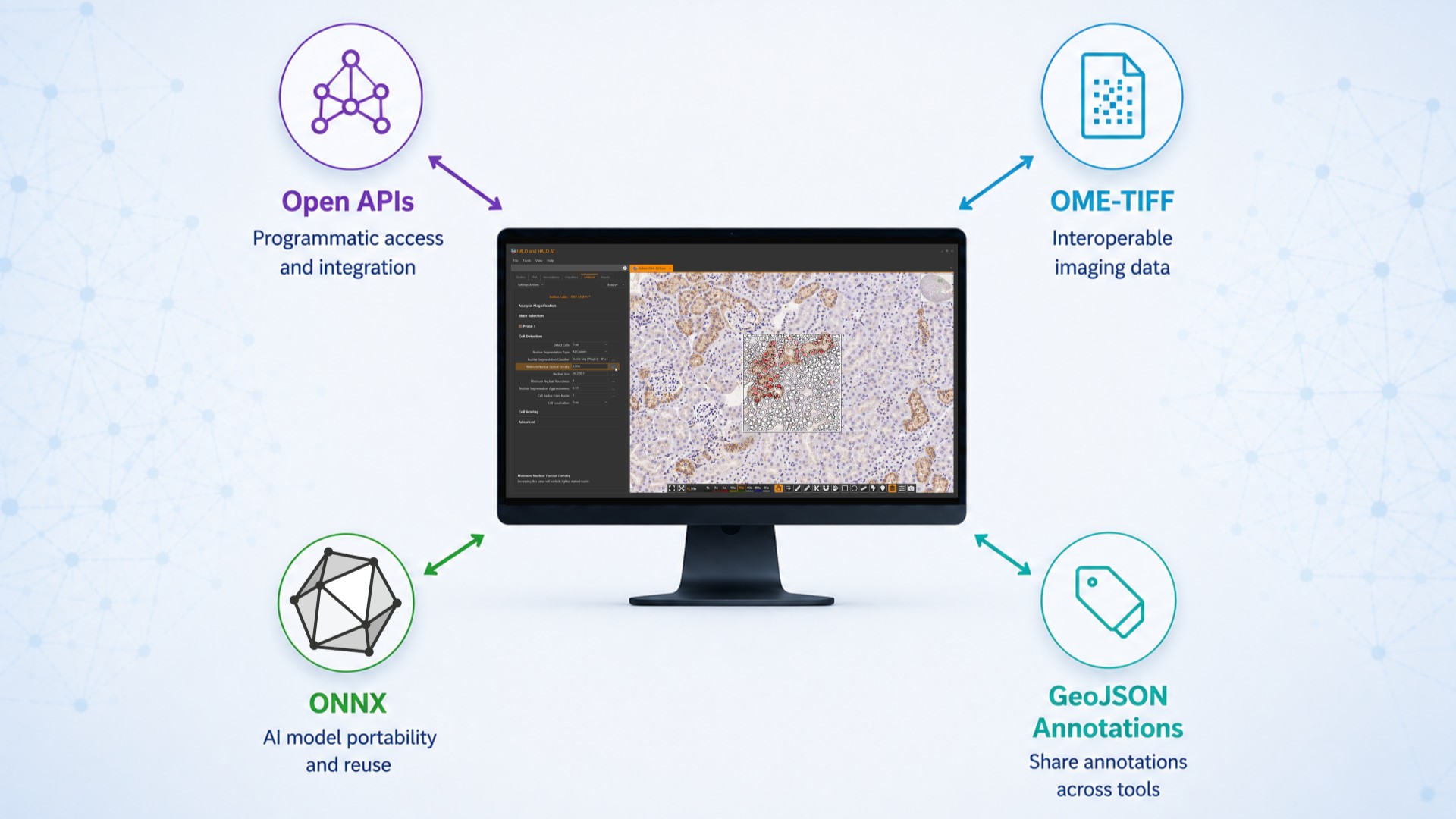
Design features that enable compatibility and portability across a collaborative, integrated image analysis workflow are foundational to open pathology.
The future of scientific discovery is increasingly shaped by the principles of open science. Researchers around the world are working to make data more accessible, experiments more reproducible, and scientific collaboration more effective. These goals have become especially important in digital pathology, where advances in whole slide imaging, multiplexed tissue analysis, and artificial intelligence are generating unprecedented volumes of data.
As digital pathology workflows become more sophisticated, researchers often need to move images, annotations, analysis results, and AI models between multiple tools, collaborators, and institutions. In this environment, openness is essential. However, there is a common misconception that deserves clarification:
Supporting open science does not require a platform to be open source.
The Real Requirement: Interoperability
For most researchers, the greatest barrier to open science is not whether software source code is publicly available, but whether data, models, and workflows can move freely between systems without becoming locked into a single platform. Open science succeeds when barriers to transferring and accessing data, between platforms and teams, are functionally eliminated. This goal depends on portability and compatibility throughout the research workflow.
Platform developers can actively support open science by embracing open standards, enabling integration with external tools, and ensuring that users retain ownership and control of their data and analytical assets. Conversely, even highly capable software can hinder collaboration if it relies on proprietary formats that isolate data or prevent interoperability.
In practice, openness is less about how software is built and more about how effectively it connects to the broader scientific ecosystem.
Open Pathology as the Foundation of Open Science
Digital pathology has emerged as one of the most data-intensive areas of biomedical research. Whole-slide images may be analyzed by multiple algorithms, reviewed by geographically distributed teams, and incorporated into larger bioinformatics or machine learning pipelines. Supporting these workflows requires a common language that allows different technologies to work together, and open standards provide this foundation.
Standards such as OME-TIFF for imaging data, ONNX for AI model portability, and GeoJSON for annotations enable researchers to exchange information between platforms while preserving fidelity and context. These standards help ensure that valuable data, models, and results remain accessible long after a project is completed.
Without open standards, collaboration often becomes fragmented, requiring duplicated effort, custom data conversions, and specialized workflows that can slow scientific progress.
Building HALO Around Open Pathology Principles
At Indica Labs, we believe that open pathology is essential for advancing scientific discovery. While our HALO®, HALO AI, and HALO Link platforms are not open-source software, they have been intentionally designed to participate in and strengthen the broader digital pathology ecosystem through interoperability, standards support, and integration capabilities.
This commitment to building an open platform rather than a “walled garden” has guided the development of our HALO®, HALO AI, and HALO Link across the years.
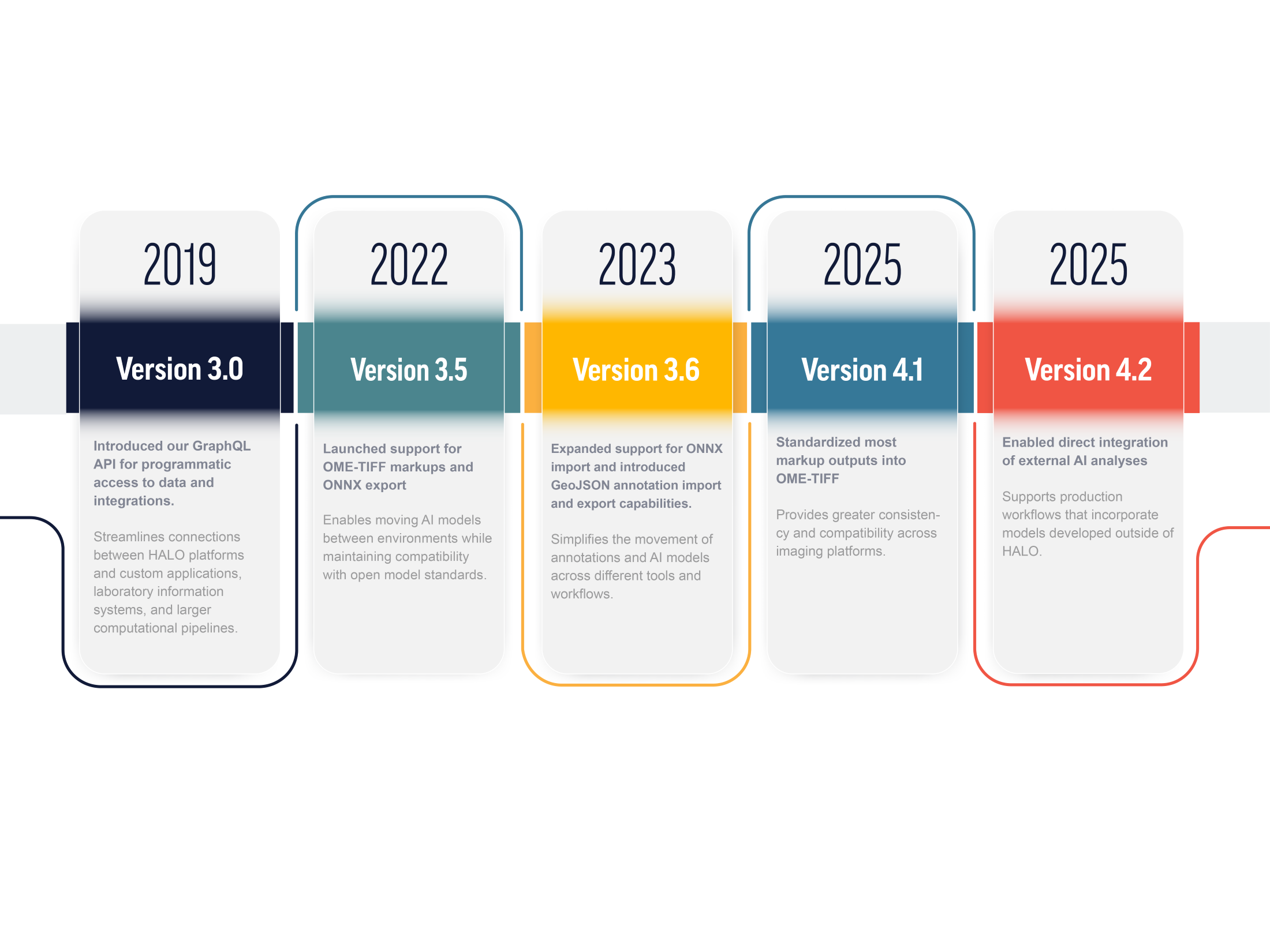
The recent integration between HALO Link and Visiopharm’s Discovery software illustrates this approach in practice. Researchers can view annotations, regions of interest, image markups, and analysis results generated in Discovery directly within HALO Link, enabling laboratories to build customized digital pathology ecosystems that leverage multiple technologies within a unified workflow.
What Open Pathology Means for Scientists
The benefits of open pathology extend beyond technical compatibility. Open standards improve reproducibility by enabling validation across institutions and software platforms, accelerate innovation by allowing teams to build on existing datasets and models, and reduce long-term risk by keeping data and analytical assets portable.
Open ecosystems also empower scientists to choose the tools that best address their research questions. Instead of forcing workflows to conform to a particular platform, interoperable solutions adapt to the needs of researchers and their collaborators.
This flexibility becomes increasingly valuable as digital pathology continues to evolve and new technologies emerge.
Open Science Through Open Ecosystems
Open science depends not on how software is licensed, but on how effectively researchers can share data, reuse models, and integrate workflows across technologies. It requires an ecosystem in which tools can communicate effectively, data remains portable, and researchers can seamlessly collaborate, validate, and innovate.
Open pathology makes this possible by providing the standards and interoperability needed to connect diverse technologies into cohesive workflows. By embracing standards such as OME-TIFF, ONNX, GeoJSON, and open APIs, HALO platforms actively contribute to open science while continuing to deliver the performance, support, and specialized capabilities required for large-scale research.
Contact us today at info@indicalab.com to discuss how our image analysis and enterprise image management platforms can integrate with and advance your digital pathology ecosystem.