
Lab Logic Brings Intelligent Case Orchestration to HALO AP® and HALO AP Dx
Lab Logic is a configuration layer that enables labs to tailor HALO AP® to their preferred workflow, enabling any lab, regardless of case volume, to operate like an automated triage engine, continuously analyzing incoming slides; triggering AI-driven actions; and delivering the right cases to the right experts at the right time.
Creating an Active Ecosystem
The shift to digital pathology has produced enormous volumes of data. Whole slide images (WSI) are scanned, stored, and archived at scale, but in many laboratories, those slides still end up sitting in static digital folders or passive worklists. Despite advanced imaging and AI* algorithms, the workflow often remains reactive, and pathologists must manually locate, sort, and prioritize cases before meaningful analysis begins.
The next phase of digital pathology is not just about viewing images, it’s about creating an active ecosystem where software intelligence organizes, routes, and prepares cases before a pathologist even begins their workday. In this model, the platform is not only performing analysis; it is orchestrating the workflow that surrounds it.
HALO AP® and HALO AP Dx 2.5 introduce Lab Logic, the user-defined workflow and orchestration system, enabling any lab, regardless of case volume, to operate like an automated triage engine, continuously analyzing incoming slides; triggering AI-driven* actions; and delivering the right cases to the right experts at the right time.
*AI capabilities are not available in HALO AP Dx.
Driving Action, Not Just Analysis
Lab Logic is a configuration layer that enables labs to tailor the software to their workflows. It includes tools for workflow design prior to clinical lock, as well as automation for case triage, workflow routing, and report prefill.
The latest version of HALO AP® expands this layer with Automatic Actions and Post-Analysis Automation, enabling dynamic case and slide lists and automated case triage. This automation streamlines digital pathology workflows by reducing manual case triage, ensuring consistent application of AI tools, and accelerating access to quantitative results for pathologist review.
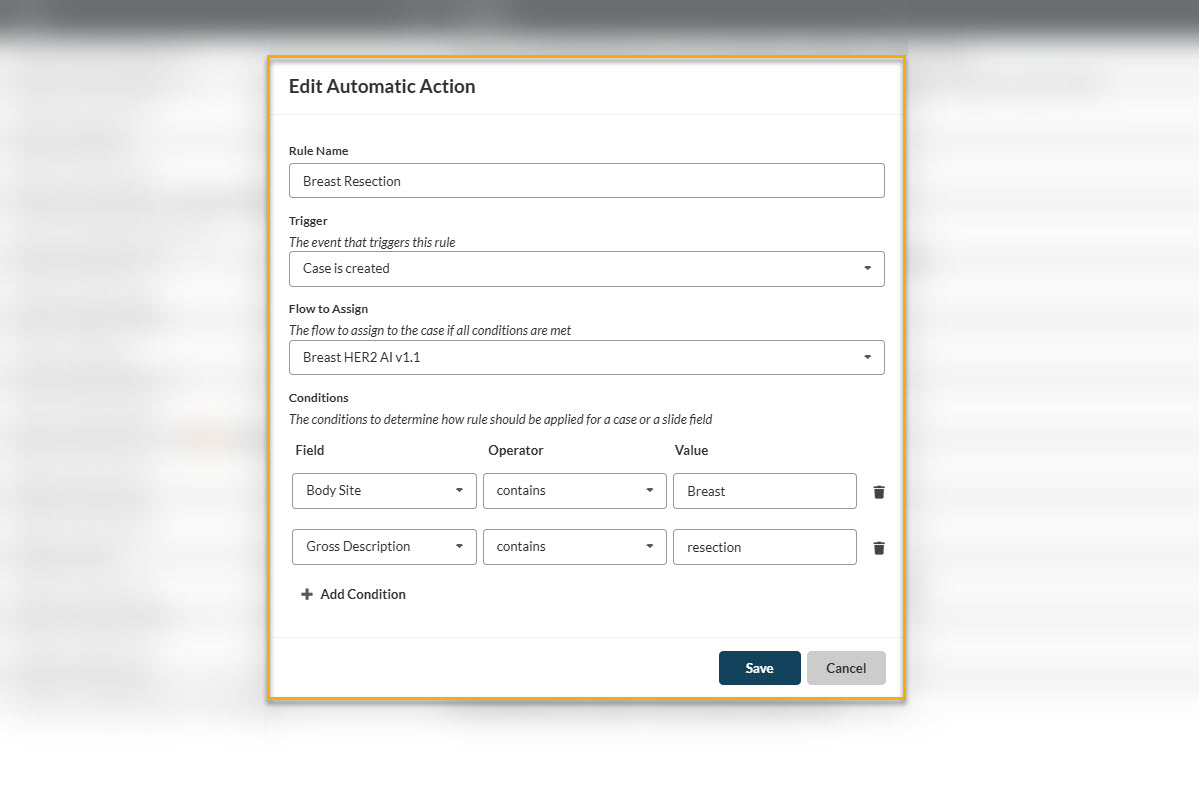
Here you see an automatic action configured to run Breast HER2 AI v1.1 on slides that meet specific criteria: a body site of breast and a gross specimen description indicating a resection. When both conditions are met, Breast HER2 AI is automatically applied to the slide without requiring manual intervention.
Expanding Capability with Third-Party AI
Modern orchestration frameworks, like Lab Logic, allow laboratories to integrate third-party AI* models without complex backend development. This is especially important for labs adopting companion diagnostic algorithms, vendor-neutral AI* ecosystems, and rapidly evolving specialty models.
Rather than rebuilding infrastructure each time a new AI* is introduced, orchestration layers allow labs to use additional algorithms and immediately apply workflow logic to their results without risking compliance or downtime.
*AI capabilities are not available in HALO AP Dx.
All examples patient data displayed in this document are for illustrative purposes only.
The real transformation occurs when orchestration and case management seamlessly work together.
Instead of waiting in a static folder or in local queues, cases and slides dynamically appear in the appropriate workspace as soon as relevant insights are generated. A key operation advantage is that workflow behavior can be configured directly by lab leadership, rather than requiring IT-driven backend changes or custom development. This allows lab managers to adapt processes quickly as clinical priorities evolve or new AI* models are deployed. At the same time, personalization features such as configurable display formats, prioritized fields, and AI* overlays ensure that the most critical information is front and center during case review and sign-out.
*AI capabilities are not available in HALO AP Dx.
Real-World Use Case: Multi-Site Healthcare Network
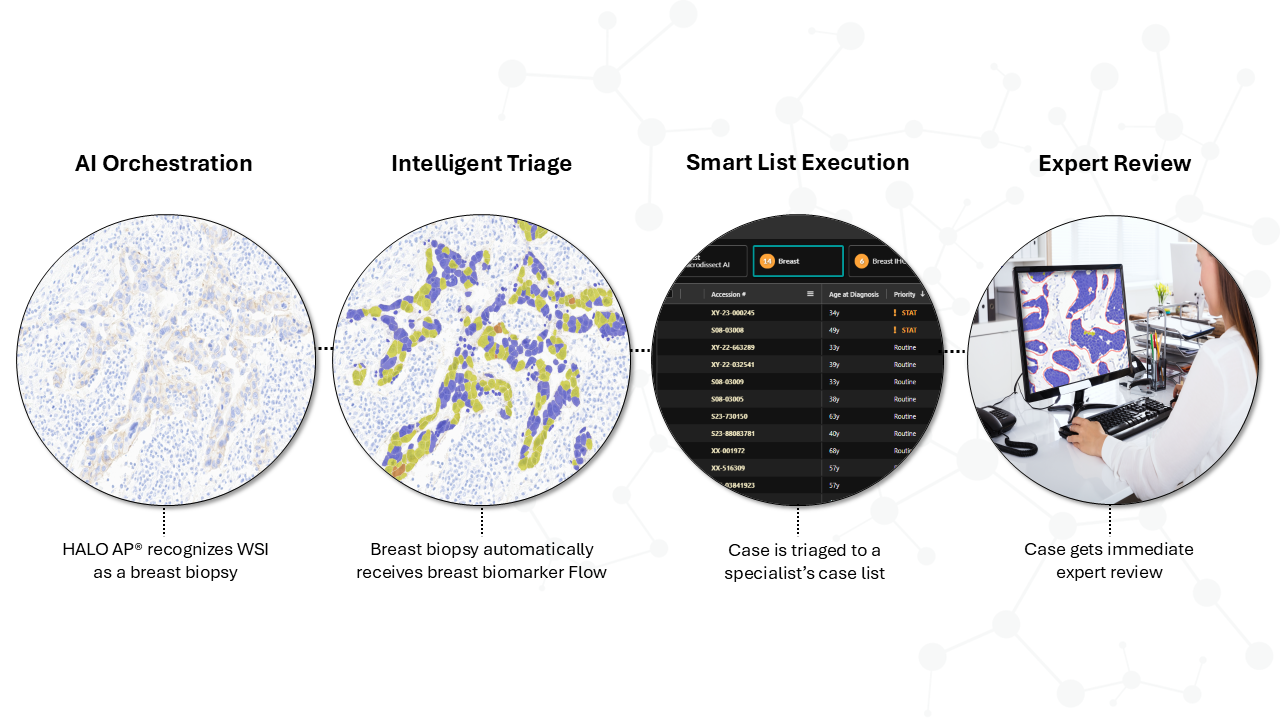
In a multi-site hospital system, Lab Logic is used for AI orchestration and intelligent case list triage, transforming a fragmented pathology network into a coordinated, high-efficiency diagnostic engine.
Imagine a large healthcare system consisting of:
- One centralized academic medical center
- Five regional community hospitals
The community hospitals lack on-site subspecialists for complex diagnoses such as rare cancers or specialized IHC interpretation.
Step 1, Orchestration: A slide is scanned at a regional hospital and through configurable automation and orchestration, tissue type and stain profile are immediately detected. A breast biopsy slide with HER2 staining has “Breast” and “HER2” slide labels automatically added to the slide.
Step 2, Intelligent Triage: The system automatically runs a quantification algorithm for HER2, and the results fall into a borderline category. The case is automatically flagged for priority or STAT review.
Step 3, Smart List Execution: Rather than remaining in a local queue, the case is automatically routed to a breast pathology specialist group at the central academic hub.
Step 4, Role-Based Access: At the central site, pathologists see a priority multi-site dashboard where cases appear pre-organized and pre-formatted with AI* overlays.
The impact of this workflow is significant…
A patient in a rural or community setting receives a subspecialist diagnosis within hours, instead of days, because the digital workflow eliminates physical glass slide transport, manual sorting, and administrative delays.
*AI capabilities are not available in HALO AP Dx.
Conclusion
Digital pathology created the data foundation, AI* provides the analytical layer, and now orchestration is delivering the operational intelligence needed to fully realize the value of both. With the new Lab Logic functionality in HALO AP® and HALO AP Dx, laboratories and major medical institutions alike will benefit from configurable, automatic orchestration and intelligent case list workflows. Users will see benefits with faster turnaround times, reduced clinician burnout, and scalable infrastructure that adapts as new AI* tools emerge. Ultimately, the future of pathology is not just about viewing digital slides, it’s about the software understanding what to do with each case before a pathologist even clicks open.
*AI capabilities are not available in HALO AP Dx.
Regulatory
Breast Macrodissect AI is for Research Use Only and not intended for clinical diagnostic use. Breast Macrodissect AI is accessed via the HALO AP® enterprise digital pathology platform.
HALO AP Dx (K252762) is FDA-cleared for primary diagnostic use with the Leica Biosystems’ Aperio GT 450 DX Scanner and Hamamatsu NanoZoomer® S360MD Slide scanner in the USA. In addition, HALO AP Dx provides built-in compliance with FDA 21 CFR Part 11 and HIPAA.
HALO AP® is CE-IVDR marked for in-vitro diagnostic use in Europe, the UK, and Switzerland. HALO AP® is For Research Use Only in the USA and is not FDA cleared for clinical diagnostic use. In addition, HALO AP® provides built-in compliance with FDA 21 CFR Part 11, HIPAA, and GDPR. WBS-MAR-000023v1