
Updated HALO® Multiplex IHC and Highplex FL Modules Deliver Greater Analysis Flexibility and Deeper Cellular Insight
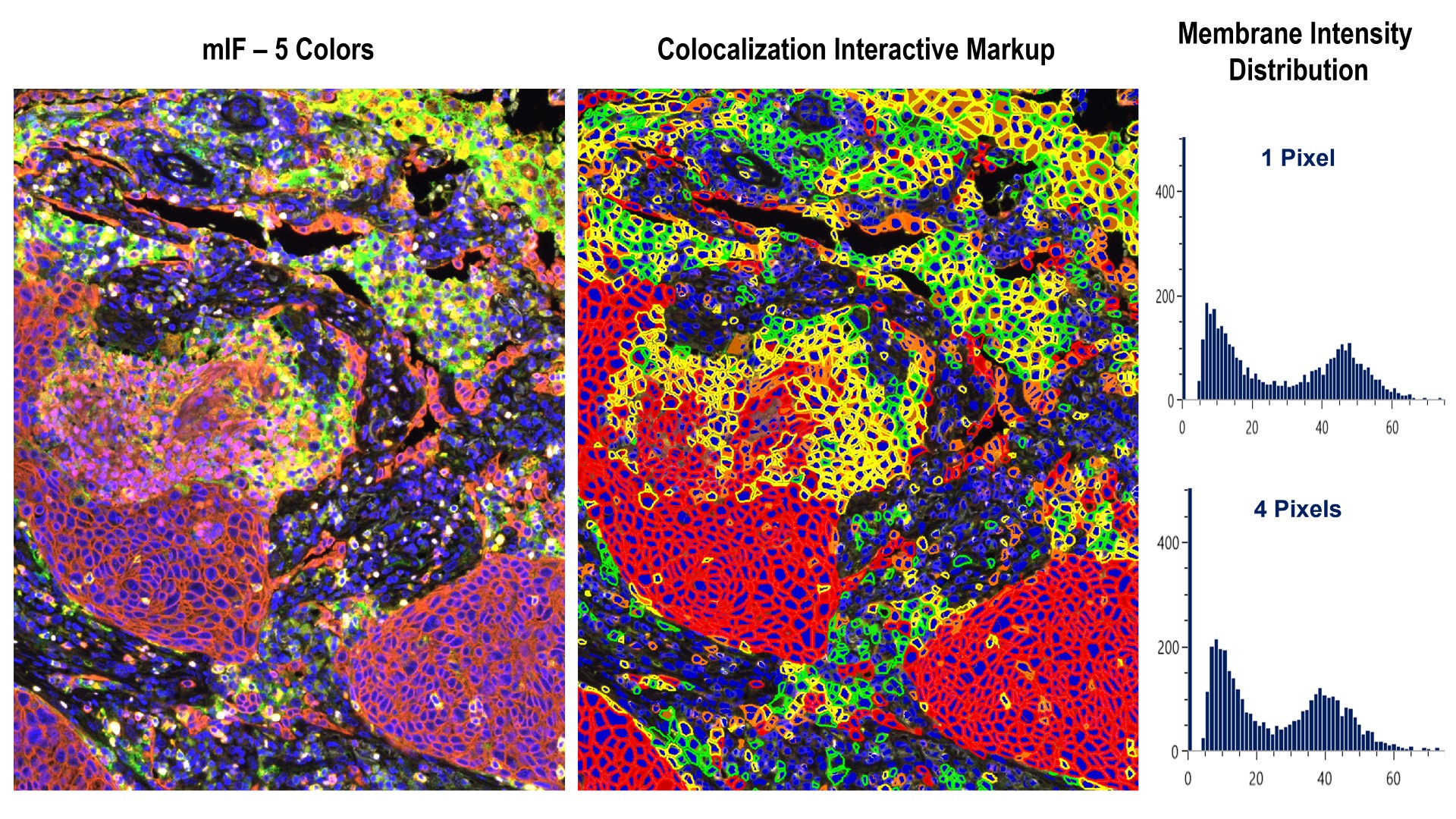
Albuquerque, NM, November 19, 2026 – Indica Labs, the trusted global leader in AI-powered digital pathology, today announces the release of the latest versions of its HALO® Multiplex IHC and Highplex FL modules for multiplex image analysis of whole slide pathology images. The update delivers powerful new functionalities that enhance detection of membrane biomarkers, expand available data outputs and control over postprocessing, and improve selection of positivity thresholds in brightfield images.
Among Indica Labs’ most popular HALO modules, Multiplex IHC and Highplex FL have supported foundational discoveries in oncology, immunology, neuroscience, and other fields, and are cited in more than 1,000 peer-reviewed publications. Multiplex IHC and Highplex FL enable quantitative per-cell analysis of protein targets across the nucleus, cytoplasm, and membrane in brightfield or fluorescence images, respectively.
The latest versions build upon the modules’ existing capabilities to offer researchers expanded toolsets for extracting biological insight from complex multiplex images. Both modules include a new adjustable membrane thickness parameter that allows users to fine-tune the setting to their specific images, improving quantification accuracy across different markers, tissue types, and assays. Additionally, users can select new object data outputs for nuclear and cellular morphology, optical density (OD) or intensity distribution statistics, and Haralick texture features.
With the latest release, users of Multiplex IHC can also leverage the threshold assistance capabilities previously introduced in Highplex FL. The Threshold Assist workflow enables researchers to pool objects across a study, visualize object counts and OD via histogram, and automate thresholding via Otsu’s method. With this new feature, HALO users can more easily set data-driven positivity thresholds whether they are analyzing brightfield or fluorescence images.
Lastly, users can now control the amount of postprocessing applied to outputs from embedded AI classifiers and nuclear and cell segmenters. When postprocessing is disabled, the modules preserve the original nuclear and cell segmentation results.
“Researcher input guides development across our products, and the latest versions of Multiplex IHC and Highplex FL are no different,” noted Dr. Noemi Kedei, Director of Product, Life Sciences at Indica Labs. “This release answers the community’s need for more flexibility in membrane analysis, consistent thresholding across brightfield and fluorescence images, and deeper object-level data, equipping researchers for discovery at the leading edge of tissue and biomarker analysis.”
The new versions of the Multiplex IHC and Highplex FL modules are available now in HALO 4.4. To learn more about the modules and how they can advance your multiplex image analysis projects, reach out to info@indicalab.com to schedule a software demonstration or to activate a trial.
About Indica Labs
Indica Labs, the global leader in AI-powered digital pathology, is redefining medicine with pathology platforms supporting life science discovery, translational research, clinical workflows, and companion diagnostic development. HALO platforms integrate image management and quantitative image analysis to deliver standardized, reproducible tissue-based analysis at every stage of the translational journey.
Media Contact
Ben Dyer