Highplex FL

Optimizing quantitative analysis of highly multiplexed CODEX images in HALO

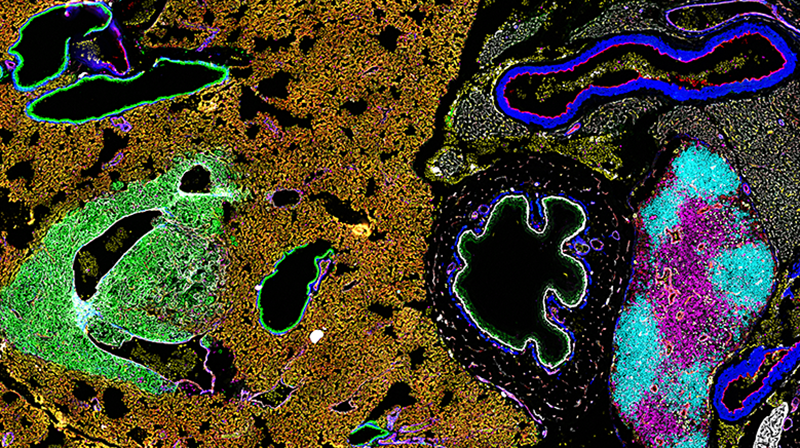
31 March 2022 | In this webinar, Dr. Noemi Kedei, a staff scientist at the Collaborative Protein Technology Resource core of the Center for Cancer Research (CCR) at the National Cancer Institute, will present a comprehensive CODEX workflow, from image acquisition to image processing and HALO image analysis. Dr. Kedei leads the core facility that provides this technology as service to CCR investigators, including project consultation and design, antibody panel customization, tissue staining and imaging, image processing, and data management. Since Dr. Kedei and team were an early adopter of the CODEX platform, they have acquired deep expertise in CODEX, having imaged hundreds of mouse and human fresh frozen and FFPE tissues in support of multiple NCI/CCR projects.

Optimizing quantitative analysis of highly multiplexed CODEX images in HALO Read More »

Tumor-specific tumor-resident cytotoxic T cells predict recurrence in stage III melanoma patients treated with adjuvant immunotherapy

20 January 2022 | In this 60-minute webinar, learn how HALO and HALO AI collaborate to perform tissue and cell segmentation, quantification of T-cell subsets in tumor regions, and spatial analysis .

Tumor-specific tumor-resident cytotoxic T cells predict recurrence in stage III melanoma patients treated with adjuvant immunotherapy Read More »

2021 Masterclass: Deep Dive into AI-Based Nuclear Segmentation and Phenotyping Part II

04 November 2021 | Following up on our HALO 3.2 Masterclass: Deep Dive into AI-based Nuclear Segmentation and Phenotyping, in this Masterclass webinar with HALO 3.3, we will further delve into options for AI-based nuclear segmentation and phenotyping.

2021 Masterclass: Deep Dive into AI-Based Nuclear Segmentation and Phenotyping Part II Read More »

THYROID MALT LYMPHOMA:  SELF-HARM TO GAIN POTENTIAL T-CELL HELP

28 October 2021 | The development of extranodal marginal zone lymphoma of mucosa-associated lymphoid tissue (MALT) is driven by chronic inflammatory responses and acquired genetic changes.  To investigate its genetic bases, we performed targeted sequencing of 93 genes in 131 MALT lymphomas including 76 from the thyroid. We found frequent deleterious mutations of TET2 (86%), CD274 (53%), TNFRSF14 (53%) and TNFAIP3 (30%) in thyroid MALT lymphoma.

THYROID MALT LYMPHOMA:  SELF-HARM TO GAIN POTENTIAL T-CELL HELP Read More »

Automated detection and quantitation of gastric immune cells in a mouse model of Helicobacter pylori­-driven preneoplastic progression

21 October 2021 | Gastric cancer is the fourth-leading cause of cancer death worldwide. About 80% of cases are attributable to infection with the bacterium Helicobacter pylori (Hp). Untreated Hp infection causes lifelong stomach inflammation that does not eradicate the bacterium. In some individuals, stomach inflammation leads to preneoplastic progression, a series of sequential tissue changes including loss of gastric acid-producing parietal cells, metaplasia, dysplasia, and finally cancer.

Automated detection and quantitation of gastric immune cells in a mouse model of Helicobacter pylori­-driven preneoplastic progression Read More »

CD38 in the Prostate Tumor Microenvironment

6 October 2021 | CD38, a druggable ectoenzyme, is involved in the generation of adenosine, which is implicated in tumor immune evasion. Its expression and role in prostate tumor-infiltrating immune cells (TIICs) have not been elucidated.

CD38 in the Prostate Tumor Microenvironment Read More »

Approaches to Analyzing Skin Tissue using HALO and HALO AI

6 May 2021 | Application Scientist, Natasha Carmell, will discuss and demonstrate workflow approaches for analysing skin sections stained with H&E and immunofluorescence. Using HALO AI we will identify and segment the corneal layer, epidermis, dermis, cartilage, sebaceous glands and lesions in H&E murine auricular tissues, followed by the segmentation of carcinoma from melanoma in fluorescent multiplexed Melanoma tissue. This AI based tissue segmentation will then be combined with biomarker quantification to identify CD8, CD68 and PDL1 positive populations using Highplex FL.

Approaches to Analyzing Skin Tissue using HALO and HALO AI Read More »

Multiomic analysis and immunoprofiling reveal distinct subtypes of human angiosarcoma

Jason Yongsheng Chan,et al, The Journal of Clinical Investigation, 2020.
To molecularly characterize the rare and aggressive tumors known as angiosarcomas, Chan et al utilized a combination of transcriptomic immuno-oncology profiling with multiplex immunohistochemistry and immunofluorescence. HALO image analysis software was used for the quantification of PD-L1, CD68, CD8, FOXP3, CD15, and ERG. From these studies, three phenotypes of patients were identified according to etiology, anatomical origin, signaling pathways, and the tumor inflammation signature. These distinct biological phenotypes provide opportunity for future studies to improve prognosis and treatment of a rare and deadly disease.

Multiomic analysis and immunoprofiling reveal distinct subtypes of human angiosarcoma Read More »

Comparison of stain co-localization in IHC sequential cuts and true co-expression in mIF images from Polaris

8 April 2021 | The webinar will cover a workflow for performing stain co-localization analysis in sequential IHC cuts through color deconvolution, slide registration, and cell-type classification, including export using registered coordinates. The resulting co-localization output will be compared and contrasted to true co-expression on a single slide using mIF techniques (Polaris).

Comparison of stain co-localization in IHC sequential cuts and true co-expression in mIF images from Polaris Read More »

HALO Image Analysis Masterclass Series: February-March 2021

Spring of 2021 | Indica Labs is excited to continue our HALO® Masterclass Webinar Series this winter. Each masterclass webinar will offer a deep dive into a specific module or capability within our HALO, HALO AI, HALO Link or HALO AP platforms, presented by our expert team of application scientists who train and support our customer base worldwide.These webinars are suitable for prospective customers who want to see a more in depth demonstration as well as current users looking for refresher training or additional tips and tricks.Registration is required for each webinar and participation will be limited, so early registration is encouraged.

HALO Image Analysis Masterclass Series: February-March 2021 Read More »

Scroll to Top